



Facebook Twitter LinkedIn RSS
    Trending
    • Spectranet, Starlink lead Nigeria’s ISP market as subscriber base hits 420,989 in Q2 2026
    • Why an OPay listing would matter for the NGX — if it happens
    • Sharing your mobile hotspot in Nigeria: Does it really put you at risk of a cybercrime probe?
    • Rethink development strategy for digital growth, Inuwa urges Jigawa State
    • INEC website defaced with foreign casino content months to 2027 general elections
    • Tony Elumelu exits UBA after 12 years of digital scaling and Pan-African growth
    • Nigeria First Policy: A Major Protection for Creatively Ambitious Entrepreneurs — Leo Stan Ekeh
    • NITDA cleared 1,056 IT project proposals valued at ₦3.84 trillion in three years
    Facebook Twitter LinkedIn
    ITPulse.com.ngITPulse.com.ng
    • News
    • Interviews
    • Blogs
    • Analysis
    • Opinion
    • Videos
    • Press Releases
    • Pictures
    • Advertise
    ITPulse.com.ngITPulse.com.ng
    Home»Opinion»Unlocking Africa’s AI Potential, By Hannro Steenekamp
    Opinion 3 Mins Read

    Unlocking Africa’s AI Potential, By Hannro Steenekamp

    mmBy ITPulseFebruary 23, 20243 Views
    Facebook Twitter WhatsApp Pinterest LinkedIn Reddit Tumblr Email
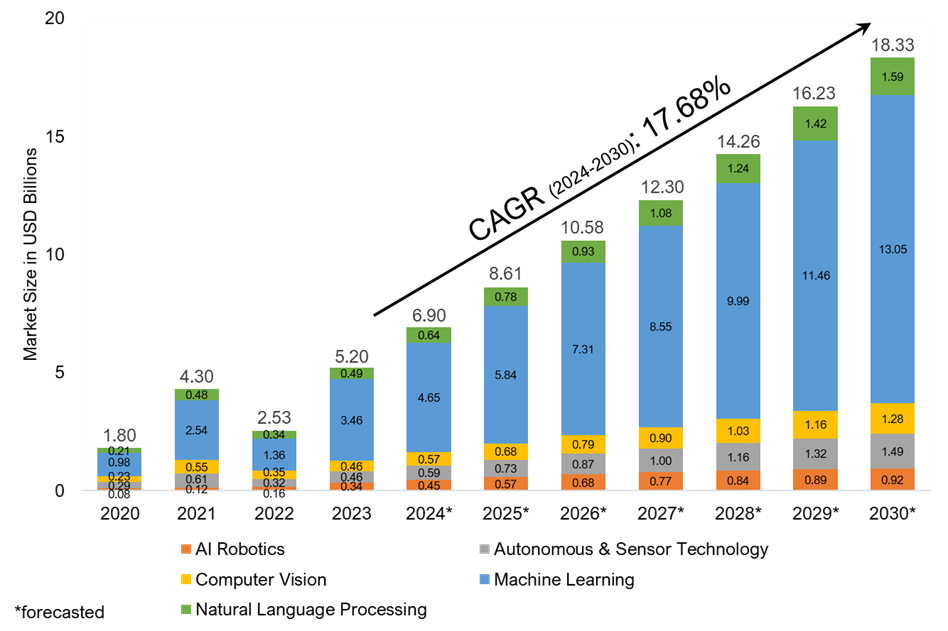
    AI Market Size, Africa, 2020 – 2030
    Share
    Facebook Twitter LinkedIn Pinterest Email

    In 2024, Africa stands at the precipice of an Artificial Intelligence (AI) revolution. With a projected market size of USD 18.33 billion by 2030, the continent is poised to harness the power of AI to tackle pressing challenges such as poverty alleviation, improved healthcare delivery, and agricultural efficiency. These AI-driven solutions hold the key to unlocking unprecedented growth and sustainable development.

    The potential for AI in Africa is vast, with a particular focus on the Machine Learning (ML) industry, which will account for 71% of the market by 2030. Machine learning enables systems to learn and adapt from data without explicit programming. This capability is particularly valuable in Africa, where datasets are often large and complex, making ML ideal for identifying patterns and trends to drive transformative solutions. As the African AI market experiences a CAGR of 17.68% from 2024 to 2030, the continent has a unique opportunity to leverage this technology for sustainable development.

    One key opportunity lies in the education sector, where AI-powered tools can help bridge the gap in skilled workers. AI can provide personalised learning experiences, adaptive tutoring systems, and automated grading that allow educators to reach more students and provide targeted support. By 2030, the number of AI tool users in Africa is expected to grow from 3.64 million to 14.47 million. This user surge can be attributed to the increasing demand for AI-driven solutions in various sectors, such as healthcare, agriculture, and finance, highlighting the need for widespread AI literacy and skills development.

    In healthcare, AI can help improve disease detection and prevention, while in agriculture, it can optimise crop yields and combat challenges like locust infestations. In finance, AI can facilitate smoother B2B transactions and promote financial inclusion in Africa’s rising markets. However, the rapid expansion of AI presents challenges that must be addressed. For example, only 14% of companies are ready to integrate AI into their operations, and just 6% have trained more than 25% of their employees to use it. In addition, Africa currently has one of the lowest rates of employee training on Generative AI at 3%.

    To capitalise on AI’s opportunities, African nations must prioritise training and upskilling their workforce to ensure a smooth and effective integration of AI technologies. This will improve productivity, create new jobs, and stimulate economic growth. Moreover, the ethical use of AI must be a priority. Clear AI governance frameworks that respect human rights and values are essential to ensure the technology is used responsibly. Governments and businesses must collaborate to create a trustworthy AI development, use, and outcomes environment.

    In conclusion, Africa’s AI market is set to grow exponentially, presenting many opportunities for sustainable development and growth. By investing in AI education, training, and ethical practices, African nations can harness the power of AI to transform the continent and create a brighter future for its people.

    Hannro Steenekamp is Author, Frost & Sullivan Africa

    Africa's AI Potentia
    Share. Facebook Twitter Pinterest LinkedIn Tumblr Telegram Email
    mm
    ITPulse
    • Website
    • Facebook
    • Twitter
    • LinkedIn

    ITPulse is a wholly information technology communication (ICT) news website, with a special focus on the African continent. The website provides up-to-date biz-tech news, analysis and comprehensive and thorough insight into the continent's ICT terrain

    Related Posts

    Artificial Intelligence (AI) is making call centres more expensive – not cheaper, By Sanjay Govender

    August 27, 2026

    The Government’s Crypto Problem, By Mela Claude Ake

    August 22, 2026

    Five practical holiday saving habits for Nigerian households 

    August 19, 2026

    Leave A Reply Cancel Reply

    Subscribe to Updates

    Get the latest creative news from FooBar about art, design and business.

    Latest Posts

    Spectranet, Starlink lead Nigeria’s ISP market as subscriber base hits 420,989 in Q2 2026

    August 31, 2026

    Why an OPay listing would matter for the NGX — if it happens

    August 28, 2026

    Sharing your mobile hotspot in Nigeria: Does it really put you at risk of a cybercrime probe?

    August 28, 2026
    About
    About

    Itpulse.com.ng is a wholly information technology communication (ICT) news website, with special focus on the African continent. The website provides up-to-date biz-tech news, analysis and a comprehensive and thorough insight info the continent's ICT terrain.

    Contact us: editorial@itpulse.com.ng

    Facebook Twitter LinkedIn RSS
    Latest Posts

    Spectranet, Starlink lead Nigeria’s ISP market as subscriber base hits 420,989 in Q2 2026

    August 31, 2026

    Why an OPay listing would matter for the NGX — if it happens

    August 28, 2026

    Sharing your mobile hotspot in Nigeria: Does it really put you at risk of a cybercrime probe?

    August 28, 2026
    Popular Posts

    Sharing your mobile hotspot in Nigeria: Does it really put you at risk of a cybercrime probe?

    August 28, 2026

    INEC website defaced with foreign casino content months to 2027 general elections

    August 28, 2026

    NITDA cleared 1,056 IT project proposals valued at ₦3.84 trillion in three years

    August 27, 2026
    © 2017 - 2026 Itpulse.
    • Terms & Conditions
    • Privacy Policy
    • Advertise
    • Contact Us

    Type above and press Enter to search. Press Esc to cancel.