


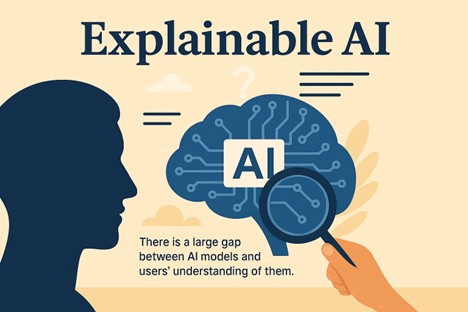
When AI Makes a Call, Who’s Accountable?
Let’s face it—AI is everywhere. It’s deciding who gets a loan, which job applicants make it to the interview stage, and even flagging suspicious transactions before humans can blink. But amid all that power, something crucial is getting lost: understanding.
Non-technical decision-makers are being asked to trust models they can’t interpret. Executives want to know why their platform rejected a loyal customer. Regulators need to verify fairness. And product teams? They’re stuck between the engineers who built the model and stakeholders asking, “Can you explain this?”
This is why Explainable AI (XAI) matters—not in a vague, academic sense—but in a direct, business-critical way. And the real game-changer? Dashboards that bring explainability to life for non-technical stakeholders.
 [Figure: Mock Explainable AI Dashboard – Feature Importance, What-If Simulation, Confidence Score]
Explainability Is Not Just a Nice-to-Have
In practical terms, here’s what’s at stake:
- Trust: Your CEO doesn’t want to “just trust the model.” They want to understand it.
- Accountability: When a decision has consequences, people want to know who—or what—made the call.
- Regulatory Pressure: From GDPR to the upcoming EU AI Act, interpretability is becoming law.
- Cross-Functional Harmony: When data scientists, PMs, and executives can all see the same picture, decisions get faster—and better.
“Trust in AI starts with clarity. And clarity begins with design.”
— Gabriel Tosin Ayodele
Turning Black Boxes into Windows
An XAI dashboard should feel less like a report and more like a conversation. It should show you not just what the model predicted—but why.
Imagine logging into a platform and seeing:
– Top Summary: “Credit risk model, 91% accuracy. Last retrained: 12 days ago.”
– Decision Rationale: “Applicant denied due to high credit utilization and short account age.”
– What-If Tool: “Increase reported income by £5,000 → approval likelihood rises to 78%.”
– Demographic Fairness Panel: “No bias detected across gender or ethnicity groups.”
This isn’t technical mumbo-jumbo. This is explainability with business context.
Good Design Makes AI Understandable
We don’t need to dumb it down—we need to design it up. Explainability is a UX problem as much as it is a data one.
That means:
- Using plain language, not just probability scores.
- Showing feature importance visually, not buried in logs.
- Letting users interact with models—tweak inputs, see outcomes.
- Telling a story—why the model made its decision, and what that means.
Tools That Help Bring This to Life
Fortunately, we’re not starting from scratch. Tools like SHAP, LIME, and InterpretML provide raw model explanations. Platforms like Streamlit, Power BI, and Dash help transform these into interactive, human-friendly visuals. Add frameworks like Alibi or services like Fiddler AI, and you’ve got a powerful modern stack for AI visibility.
Case Study: AI at a Crossroads
I once worked with a team building a credit scoring model. The data scientists were thrilled by its precision. But the business leadership was frozen. “We can’t use this,” they said, “because we can’t explain it to the board.”
We built a dashboard.
It showed top decision factors, accuracy across demographics, and let anyone simulate outcomes by changing inputs. Within weeks, adoption soared.
When people understand a system, they trust it. And when they trust it, they use it.
What’s Next for Explainable AI
Explainability won’t stop at dashboards. In the near future, we’ll see interpretability embedded in voice assistants, robotics interfaces, and AI-driven diagnostics—all of which require real-time, user-friendly insights. In highly regulated sectors like healthcare, finance, and education, this evolution is not just important—it’s inevitable.
As global standards like the OECD AI Principles and NIST AI Risk Framework mature, industry leaders will need to treat explainability not just as a feature—but as a fundamental pillar of responsible AI.
The Future of AI Is Understandable
Black boxes won’t cut it in an era of algorithmic accountability. As builders of technology, it’s on us to make AI speak human. Whether it’s a bank manager, a hospital administrator, or a parent checking school allocation—it matters.
If you’re working with AI and haven’t thought about explainability yet, you’re already behind. But the good news? It’s never been easier—or more important—to start.
About the Author
Gabriel Tosin Ayodele is an Engineering Lead with deep expertise in software engineering, data systems, artificial intelligence, and cloud technologies. He architects intelligent platforms that combine high performance with explainability, enabling transparent and trustworthy AI at scale. Passionate about digital trust and inclusive innovation, Tosin leads cross-functional teams to deliver responsible, data-driven solutions in modern cloud-native environments.