




Since the appointment of Dr. Aminu Maida as the Executive Vice Chairman (EVC) of the Nigerian Communications Commission (NCC) nearly three years ago, he has steered the regulator away from traditional “policing” toward a data-driven, consumer-centric model. Under his leadership, the NCC’s transformation projects have focused on a “Three-Pillar” strategy: the Consumer, the Industry, and the Government.
In this analysis, ITPulse’s Martin Ekpeke explores the key projects and strategic shifts defining the Maida era and their impact on Nigeria’s digital economy.

1. Data as the New Regulator: The Quality of Experience (QoE) Pivot
The most visible shift under Dr. Maida’s leadership has been the transition from monitoring “Quality of Service” (QoS) to “Quality of Experience” (QoE). This moves the regulatory focus from technical metrics, such as dropped call rates, to actual user satisfaction. To support this, the NCC has intensified the deployment of advanced monitoring tools that track real-time internet speeds and latency across various regions.
By making this performance data public, the Commission is utilizing transparency as a strategic regulatory tool. This forces major Telcos—MTN, Airtel, Glo, and 9mobile to compete on service quality rather than just price.

2. Strengthening the Digital Foundation: The Fiber Infrastructure Push
Dr. Maida identified the “middle-mile” infrastructure gap as the primary bottleneck for 5G and broadband penetration. Consequently, his administration has fast-tracked projects aimed at resolving the right-of-way (RoW) challenges that have historically hindered fiber optic deployment.
As part of a strategic engagement shift, the NCC has moved from federal-level planning to active state-level diplomacy. By working closely with the National Economic Council (NEC), the Commission aims to harmonize RoW charges across Nigeria’s 36 states. This ensures that the 70% broadband penetration target is supported by physical fiber infrastructure reaching underserved rural areas, rather than remaining a theoretical figure.
3. Regulatory Compliance and the SIM-NIN Deadline
The NCC has adopted a “zero-tolerance” approach to security compliance, treating the aggressive enforcement of the SIM-NIN linkage as a critical national security project rather than a mere bureaucratic exercise. By enforcing strict deadlines and barring millions of non-compliant lines, the Commission has successfully sanitized the national subscriber database. This action has significantly hindered the ability of anonymous actors to exploit the network for criminal activities, aligning the NCC’s operational goals with the broader national security agenda.
4. Internal Digital Transformation
Mirroring the “Smart Public Sector” approach adopted by agencies like NITDA, Dr. Maida has initiated internal reforms to fully digitize the Commission’s own processes. These efficiency gains are most evident in the automation of licensing applications and spectrum management, which has significantly reduced the “time-to-market” for new operators and technology providers.
Furthermore, the Commission has introduced a renewed focus on talent re-skilling. By training staff in Artificial Intelligence (AI) and Big Data analytics, the NCC ensures its team stays ahead of the rapidly evolving technology companies it oversees.
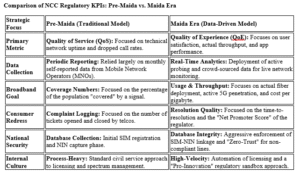 Analysis of the Strategic Shift
The NCC is increasingly utilizing transparency as a regulatory weapon by publishing public league tables for service providers, leveraging public QoE data to create market pressure for service improvements.
This strategy of infrastructure diplomacy marks a transition from being a passive federal observer to an active negotiator with state governments, ensuring fiber optic cables are treated as critical national infrastructure. Furthermore, a heightened focus on spectrum efficiency now discourages “spectrum hoarding” in favor of active deployment by license holders.
ITPulse’s Final Verdict
The transformation under Aminu Maida suggests a regulator no longer content with just issuing fines. Instead, the NCC is positioning itself as an enabler of the digital economy. By focusing on consumer rights, infrastructure transparency, and strict compliance, Maida is building a high-velocity regulatory environment that balances investment protection with the public interest.
While the volatile economic climate and its impact on the Capital Expenditure (CAPEX) of telecom operators remain a challenge, the NCC is now better equipped to navigate these headwinds with a solid, data-driven foundation.