



By Martin Ekpeke
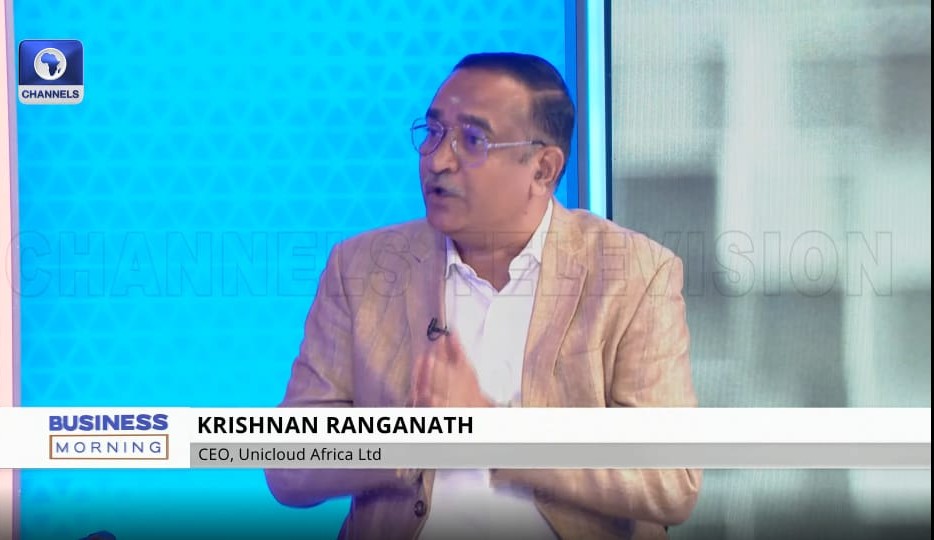
The escalating geopolitical instability between the U.S., Israel, and Iran should serve as a definitive wake-up call for Africa to build its own digital infrastructure and end its overreliance on foreign technology, Dr. Krishnan Ranganath, CEO of Unicloud Africa, has said.

Speaking on Channels TV’s Business Morning, Dr. Krishnan argued that as global investment flows are disrupted by war, Africa has a rare opportunity to reroute capital into the continent to build sovereign assets such as local data centers and cloud environments that ensure digital independence.
Africa currently faces a massive infrastructure gap, a situation he describes as a data drain. He explained that despite a growing tech scene, Africa hosts only about 208 data centers. As a result, 85% of African data is currently stored on servers located outside the continent, resulting in digital traffic having to travel abroad and back before reaching local users. Thus, increasing costs and security risks.
“We cannot run our digital economy based on someone else’s infrastructure,” he noted, setting a target for the continent to bring at least 50% of its data back to African soil to guarantee national security and economic stability.
Speaking further, Dr. Krishnan outlined three strategic pillars to transition Africa from a consumer to a producer of technology, emphasizing that building in-house cloud and data systems is a non-negotiable requirement for a thriving digital economy.
 While hardware remains a challenge, he noted that Africa’s young demographic, with a median age of 19 to 20, represents a goldmine for Artificial Intelligence. “Training this youth population in AI has the potential to turn the continent into a global talent hub,” he stressed.
Also, he urged the top 20–25 African economies, including Nigeria, South Africa, and Kenya, to stop acting as 54 separate markets and instead form a unified digital framework.
Ending the raw material cycle
Krishnan called for a fundamental mindset shift in how African leaders manage resources, comparing the tech sector to the oil industry, where Africa often exports crude oil only to buy back expensive refined petroleum.
“Let’s stop selling our resources and start selling finished products,” he said. In the digital age, this means processing and hosting data locally to create high-value services rather than just exporting raw talent or data to the West.
Navigating debt and power hurdles
The CEO acknowledged the steep mountains the continent must climb, particularly Nigeria’s struggle with unstable power grids and rising national debt. He proposed a Public-Private Partnership (PPP) model as the only viable way forward.
By providing the right incentives and regulatory frameworks, Krishnan believes governments can empower the private sector to lead the infrastructure charge, even when public funds are tight.
“Africa is no longer an option or a chance; it is the future standing in front of us. We have the brains; we just need to take this chance to fast-track the build and bring Africa to the front,” he concluded.