



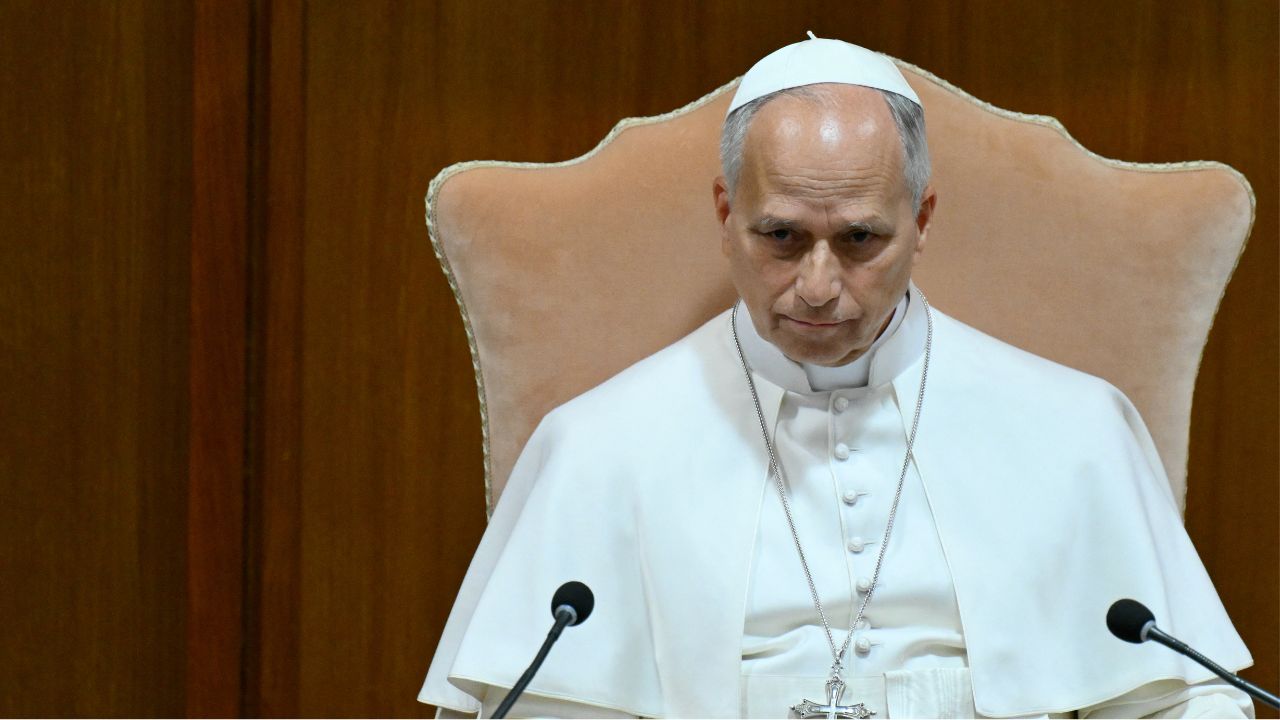
On Monday, Pope Leo XIV stood at the Vatican and presented Magnifica Humanitas, an 83-page document on artificial intelligence, human dignity, and the direction of a technology reshaping the world. Standing beside him was Christopher Olah, co-founder of Anthropic, one of the most powerful AI companies on the planet.
That image pointed to something very uncomfortable; the people the Pope was critiquing had a seat at the table, but Africa’s representatives were missing.

That irony is worth noting because, if you strip the theological language from Leo’s encyclical and read it as a policy document, it articulates exactly what is wrong with how artificial intelligence is being developed and deployed in the world’s most marginalized regions.
What the Pope actually said
Leo signed the encyclical on May 15, the 135th anniversary of Rerum Novarum, the 1891 document in which Pope Leo XIII addressed workers’ rights during the Industrial Revolution. Leo XIV believes AI poses the same civilisational questions that industrialisation did, and that the church has an obligation to weigh in.
The document is not in any way a condemnation of AI. Leo writes that technology “has the power to heal, connect, educate and protect our common home.” But he is clear about where the danger lies.
“The main drivers of development are private, often transnational, parties that are endowed with resources and the capacity to intervene that surpass those of many Governments,” he writes. AI power is becoming, in his phrase, “predominantly private”, and that makes it harder for states to govern, and easier for it to serve profit over people.
He calls out job displacement directly: “The pursuit of greater profits cannot justify choices that systematically sacrifice jobs, because the human person is an end, not a means.” He demands robust external regulation, “a more moral AI is not enough if that morality is determined by a few.” And he specifically warns against AI-assisted autonomous weapons systems, declaring it “not permissible” to allow machines to make irreversible lethal decisions without human oversight.
Why this lands differently in Africa
While the world’s coverage of this document will focus on its implications for Washington and Silicon Valley, it reads differently for Nigeria and the rest of Africa.
The continent’s relationship with AI is almost entirely that of a consumer. The models being deployed across Nigerian fintech, Nigerian healthcare, Nigerian media verification (OpenAI, Google, Anthropic, Meta) are trained on data that barely represents African languages, contexts, or social realities. They are built by companies whose headquarters are in San Francisco and whose primary accountability is to American shareholders and, increasingly, the American government.
Leo’s warning that transnational tech companies now hold “resources and capacity to intervene that surpass those of many Governments” is not an abstract concern in Lagos or Nairobi. It is a description of a condition these cities already live in. When Anthropic and OpenAI are valued at hundreds of billions of dollars (more than the GDP of many African nations, as AP reported from the Vatican launch) the power asymmetry the Pope is describing is not theoretical.
The encyclical’s concern about AI in the workplace is equally pointed for a country where youth unemployment remains one of the most urgent crises in government. Nigeria’s tech sector has been positioned, rightly, as a path out of that crisis, a sector where young, talented Nigerians can build and earn without the legacy barriers of the old economy. If AI accelerates job displacement at a global scale before Nigeria has industrialised in the traditional sense, the country faces a particularly cruel version of the problem Leo is raising.
The Anthropic problem
There is something worth noting about the Vatican’s decision to feature Anthropic’s co-founder at Monday’s launch. The company is currently in a legal battle with the Trump administration after refusing to allow the U.S. military unrestricted access to its technology. Some commentators read Anthropic’s presence as a papal endorsement. The Vatican pushed back on this framing, describing it as dialogue rather than approval.
But Leo’s own text offers no such comfort to Anthropic. He is explicit that even companies acting in good faith cannot regulate themselves: “It is not enough to invoke ethics in the abstract; robust legal frameworks, independent oversight, informed users and a political system that does not abdicate its responsibility are required.” Olah, to his credit, said as much in his own remarks, acknowledging that the incentives cannot bend moral voices.
What Nigerian policymakers should do with this
Nigeria’s National Information Technology Development Agency (NITDA) and the Nigeria Data Protection Commission (NDPC) have laid the initial groundwork for digital governance, most notably through the launch of the National Artificial Intelligence Strategy (NAIS) and the introduction of AI System Impact Assessments.
However, the country still lacks an enforceable, legally binding AI Act or a defined AI liability framework to handle algorithmic harm. Furthermore, while Nigeria is active in broad global safety coalitions like the Bletchley Declaration, it remains excluded from the exclusive multilateral tables where hard AI regulations are actively being codified, such as the G7 Hiroshima AI Process or the direct drafting consultations for the EU AI Act.
Leo’s encyclical will not change that overnight. But it does something useful: it gives African governments a moral and intellectual vocabulary, one that carries significant weight globally, to press for what the continent actually needs, representation in AI governance, protection of local labour markets, accountability from companies whose products operate at scale on African soil, and a rejection of the idea that Silicon Valley’s ethics committee is a substitute for actual regulation.
The Pope called the current moment a “change of era.” For Africa, the question is whether the continent shapes that change or, as with previous technological revolutions, absorbs its consequences.