



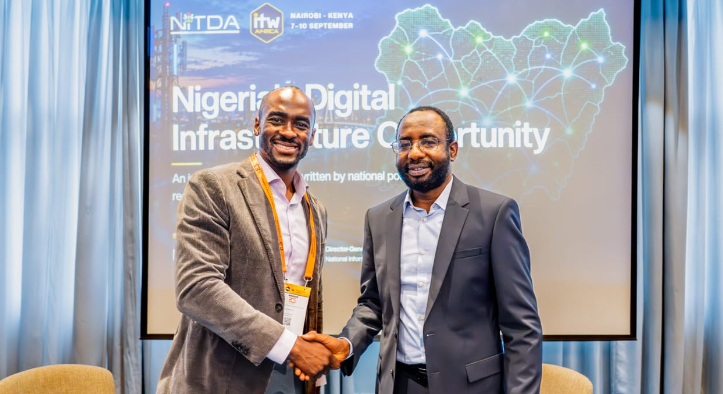
By Abigail Mbah
Nigeria is actively courting private capital by turning policy into concrete, investable demand for digital infrastructure, according to the head of its national IT agency.

Kashifu Inuwa, Director-General of the National Information Technology Development Agency (NITDA), spoke during a fireside chat titled “From Policy to Investable Demand” at the Nigerian Workshop on Nigeria’s Digital Infrastructure Opportunity, held as part of ITW Data Cloud Africa 2026. The session was moderated by Jay Katatumba, Senior Investment Director at Africa50 Infrastructure Acceleration.
Addressing data centre operators, hyperscalers, investors, financial institutions, cloud providers and connectivity companies, Inuwa described a clear shift in approach. Rather than acting solely as a traditional regulator, NITDA is positioning itself as a market enabler. The National Cloud Infrastructure Strategy, he said, is designed to convert regulatory requirements into contracted demand that private investors can bank on.
He outlined five interconnected pillars that support local innovation clusters: higher education institutions to develop skilled people, entrepreneurs willing to commercialise ideas, companies ready to hire talent and adopt solutions, risk capital to support growth, and government providing a stable enabling environment. Every regulatory step taken by the agency, Inuwa emphasised, aims to create markets, drive local innovation and protect consumers.
On the practical question of how investors move from policy talk to revenue, he pointed to existing demand signals. The Central Bank of Nigeria already requires domestic processing of financial transactions. The National Digital Cloud Policy and its accompanying investment roadmap are meant to further de-risk entry by clarifying pathways for building local data centres and developing talent pipelines.
Power reliability, a frequent concern for infrastructure investors, was addressed directly. Operators are not expected to depend only on the national grid. Regulatory frameworks allow them to develop their own captive power through renewable energy, gas-fired plants or independent power purchase agreements.
For organisations facing compliance deadlines, Inuwa described flexible hybrid models. Companies can use public cloud capacity for general processing while keeping sensitive data in local facilities, helping maintain continuity during the transition.
Strict data localisation rules, he clarified, apply mainly to sovereign data — national financial records, health metrics and intelligence information that affect economic security and citizen welfare. No country, he noted, allows such sensitive records to sit outside its jurisdiction without oversight because of the geopolitical and economic risks involved.
Looking across the wider digital stack, Inuwa stressed that connectivity, cloud computing and artificial intelligence are tightly linked. Through Project Link, the government is expanding broadband access so that more citizens become digitally visible and can be properly represented in automated systems. At the same time, the National Sovereign Cloud Initiative is intended to supply the computing capacity needed to run AI workloads locally.
Building sovereign AI capability is critical, he argued, because automated decisions increasingly influence credit assessments, healthcare allocations and judicial processes. Nigeria has already recorded progress on this front, ranking 38th globally in AI governance and policy according to international tracking metrics. The International Monetary Fund has also identified the country as a leader in Africa’s emerging AI economy.
Inuwa closed by inviting private investors to partner with Nigeria in building secure, scalable digital infrastructure that can serve the wider continent. The message was clear: the policy framework is in place, demand signals exist, and the government is prepared to work with capital providers ready to commit.