



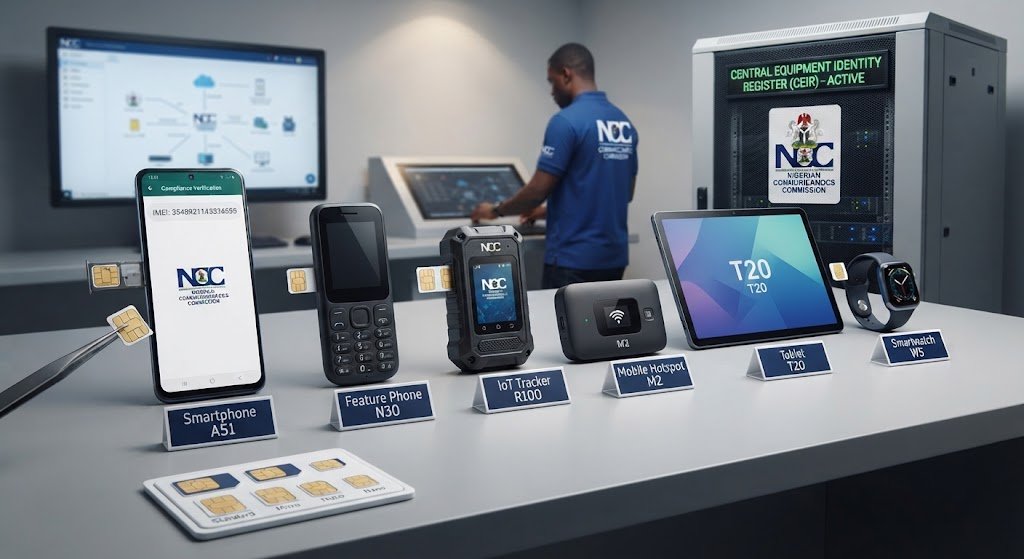
The Nigerian Communications Commission (NCC) is strengthening the monitoring and enforcement of its Type Approval requirements through an advanced, technology-enabled framework.
The decision is to ensure that all communications devices imported, sold, and used in Nigeria meet rigorous technical and regulatory standards,

According to a statement signed by Nnenna Ukoha, Director, Public Affairs at the Commission, the initiative leverages a centralized Device Management System (DMS) to make Type Approval compliance significantly more efficient, consistent, and effective.
“By automating the process, the Commission can now electronically verify the compliance status of all SIM-enabled devices operating within the country,” the statement noted.
Operating under Section 132(2) of the Nigerian Communications Act 2003, the framework mandates that licensed service providers, facilities providers, equipment manufacturers, and suppliers obtain official Type Approval from the Commission before any communications equipment is distributed or utilized in Nigeria.
Core benefits of the framework
- Improves overall compliance with established technical and regulatory standards across the domestic market.
- Prevents substandard or faulty hardware from degrading national telecommunications infrastructure.
- Facilitates the rapid identification and restriction of non-compliant and illegally imported devices.
- Strengthens consumer confidence by ensuring available devices are safe, genuine, and legally acquired.
The Commission has officially launched the first phase of this automated rollout, working in close collaboration with critical stakeholders, including the Nigeria Customs Service, Original Equipment Manufacturers (OEMs), importers, and relevant market associations.
This initial phase prioritizes the onboarding of existing devices currently held in stock, while ensuring that all future imports are properly registered and authenticated prior to entering widespread use.
Discussing the operational rollout, the NCC’s Director of Technical Standards and Network Integrity, Engr. Edoyemi Ogoh, highlighted that the Type Approval Business Rules issued in August 2024 established the regulatory backing for a Central Equipment Identity Register (CEIR) to maintain a comprehensive registry of SIM-enabled devices.
Following the issuance of those rules, the Commission conducted extensive stakeholder engagements and market studies to guide the system’s design and deployment. Through this central registry of International Mobile Equipment Identity (IMEI) numbers, the NCC can seamlessly verify that every device meets mandatory benchmarks.
“With the deployment of this system, all SIM-enabled communications devices brought into the country must be registered before they are sold,” Engr. Ogoh noted. “Devices that are not duly registered will not be permitted to operate on Nigerian networks.”
In addition to enforcing Type Approval, the platform provides critical ancillary benefits, such as simplifying the tracking and blocking of devices reported stolen across all Nigerian mobile networks. Engr. Ogoh also reassured the public that the platform’s scope is strictly limited to device identification and compliance verification, maintaining IMEI data without granting the Commission access to private user communications or personal device content.