



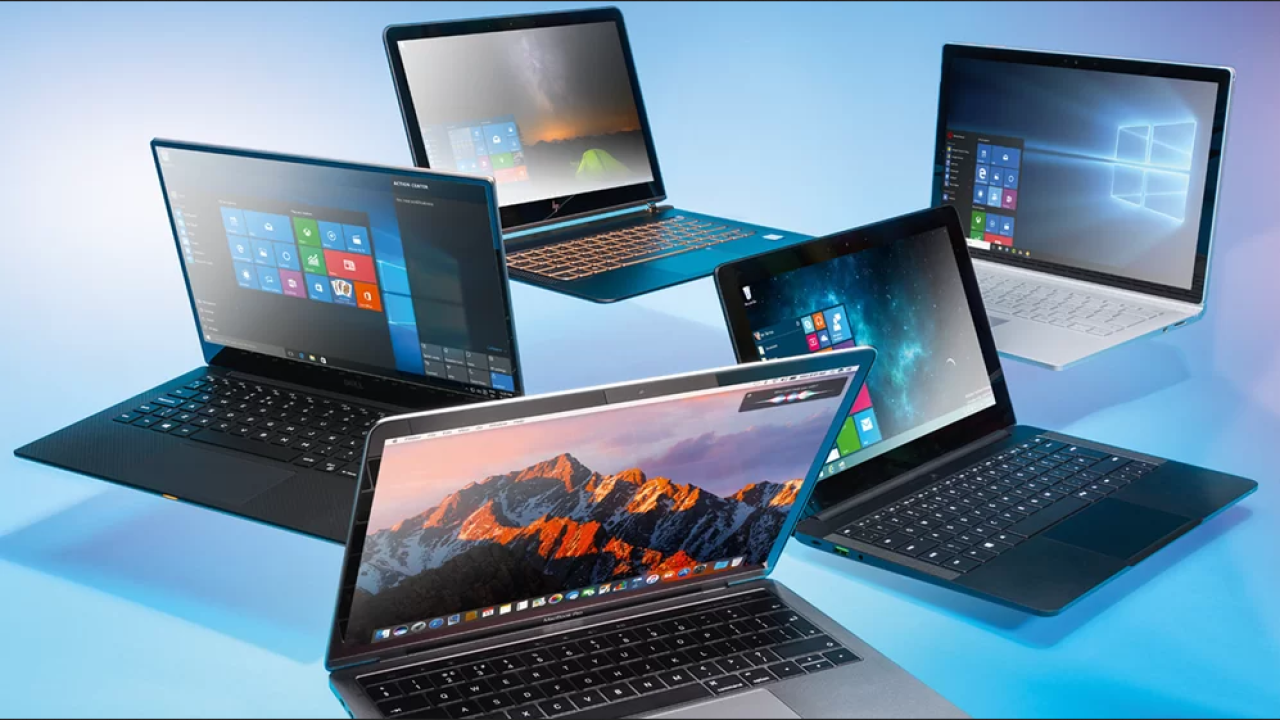
The government of President Bola Ahmed Tinubu should without delay toe the path of the Indian government which recently imposed restrictions on the import of laptops, tablets, all-in-one personal computers and ultra-small computers and servers with immediate effect.
This is in the spirit of product nationalism whereby countries deliberately promote patronage of homemade products and services to boost local productivity, create more jobs, encourage proficiency, and discourage capital flight.

In addition, this will help build faith in Nigeria which is President Tinubu’s new sermon.
Some Nigerian technocrats and ICT professionals have recommended the India policy for the Nigerian government, arguing that a ban on the importation of computers and allied hardware is what is needed to give a boost to the indigenous companies producing the same products in-country, some of which are struggling.
Mr. Chris Uwaje, a Fellow of Nigeria Computer Society (NCS) and former President, the Institute of Software Practitioners of Nigeria (ISPON) said President Tinubu should adopt the India policy as well as make it mandatory that all foreign computer manufacturers set up local production facilities in Nigeria in partnership with indigenous computer companies.
To further encourage such partnerships, he recommends that such new manufacturers should be given pioneer status incentives of a minimum of five to seven years.
Another ICT expert, Mr. Dotun Ali-Balogun urged President Tinubu to mandate that all government ICT operations are run on the technical strength of locally assembled computers.
His thought was corroborated by two other digital geeks, Messrs Michael Ikeogwu and Ayodele Ogundele who posited that now is the best time for the Federal Government to adopt the Buy-Nigeria policy in ICT as a way of discouraging capital flight and encouraging local productivity.
The new India policy is exactly what the Tinubu government should do, says Ali-Balogun.
“The Federal Government should adopt a policy that bans importation of computer hardware especially those that are already being assembled in Nigeria. This will not only help boost local production, but it will also encourage efficiency in local production, create jobs, direct and indirect, through the entire value chain, including marketers, support services and logistics,” he explains.
Nigeria has a couple of indigenous computer hardware assembling companies, with some of them having technically proven products in terms of standards. Available data lists local computer and allied product makers including RLG, Beta, Data House Technologies, Zinox, Acti-Tech Limited, among others. While it can be argued that most of them are struggling and may lack the capacity to meet local demand, the same cannot be said of Zinox which has since its roll out in 2001 as Nigeria’s first truly globally-certified computer brand gone ahead to execute mega ICT projects.
Zinox has over the years shown capacity both in Nigeria and offshore, delivering technically-demanding mega projects all globally acknowledged as excellent. In 2006 and 2011, Zinox executed two of the most time-critical ICT mega projects ever to be undertaken in Africa with the introduction of the card reader technology and the Direct Data Capture (DDC) machines respectively on behalf of the Independent National Electoral Commission (INEC). It replicated same by delivering light-years-ahead technology for the National Population Commission (NPC) for the soon-to-be-organized first digital census in Nigeria.
It has also executed major projects offshore in Guinea Bissau, The Gambia and the Arab nations through partnerships.
It will be recalled that under President Olusegun Obasanjo, a directive to Ministries, Departments and Agencies (MDAs) was enforced and many MDAs including the Central Bank of Nigeria, Nigerian Communications Commission (NCC), INEC, Federal Inland Revenue Services (FIRS), among other parastatals and tertiary institutions had their operations standardized with Zinox computers. It was also the standard system for Shell, Chevron and other private equities, including multinationals.
Again, under Obasanjo as President, Zinox powered the 8th All Africa Games codenamed COJA 2003 hosted in Nigeria; the 18th Commonwealth Heads of Government Meeting (CHOGM) hosted by Obasanjo in Abuja between December 5 and December 8, 2003, and many more. The Obasanjo directive paid off as many indigenous computer assembling companies ramped up production, improved the technical efficiency of their products and created more jobs with concomitant creation of economies of scale.
Statistics from the International Trade Centre showed that $1.09 billion was spent on software acquisition and importation of computer services into Nigeria in five years from 2016 to 2020.
The breakdown showed that software and computer services worth $123.89m were imported in 2016, the figure jumped to $216.57m in 2017, $257.55m in 2018 and dipped to $159.28m in 2019, before rocketing to $336.43m in 2020.
In recent years, indigenous ICT companies have demonstrated capacity in both software and hardware engineering such that multinationals like Microsoft, Oracle, Google, IBM are beginning to show more interest in recruiting young Nigerians.