



By Martin Ekpeke
For decades, the lecture theatres of Obafemi Awolowo University (OAU), Ile-Ife, have echoed with the rigorous pursuit of academic excellence. But today, the conversation on campus is shifting from what students know to what they can build.

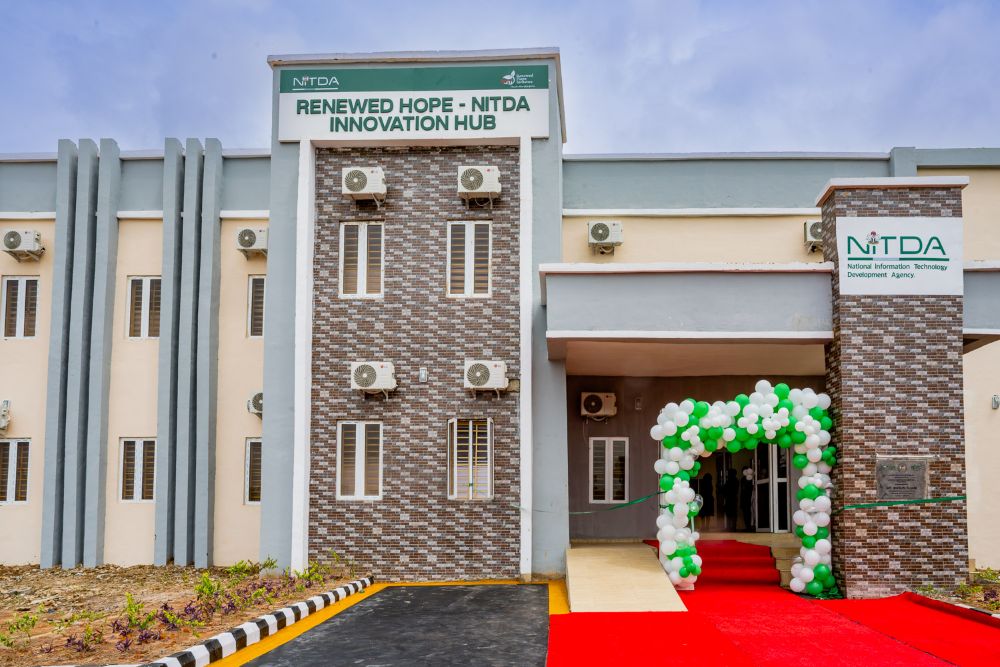
The recent commissioning of the Renewed Hope–NITDA Innovation Hub at OAU marks a pivotal milestone in Nigeria’s educational and economic evolution. Spearheaded by the Ministry of Communications, Innovation and Digital Economy alongside the National Information Technology Development Agency (NITDA), this facility is not merely a new building on campus; it is a launchpad designed to transition Nigeria from a consumer of global technology into an aggressive producer of it.
As the Minister, Dr. Bosun Tijani, aptly noted during the handover: “Innovation does not come from buildings; innovation comes from people.” By equipping Nigerian youth with unprecedented access to frontier technologies, the hub is set to trigger a dual wave of benefits: first, by radically transforming the student experience, and second, by positioning Nigeria as a dominant force in the global digital economy.
In the modern digital landscape, the traditional classroom dynamic is facing a paradigm shift. Information is no longer locked behind university library doors; as Dr. Tijani pointed out, knowledge is now ubiquitous. A student can learn the core mechanics of advanced engineering or software development via a simple internet search or an interactive prompt with Generative AI.
 The real bottleneck? The Renewed Hope–NITDA Innovation Hub directly addresses this gap by offering students a physical sandbox to experiment, fail, iterate, and succeed.
The hub systematically dismantles the financial and physical barriers that have traditionally kept African students on the fringes of tech innovation. It features specialized laboratories dedicated to:
- Artificial Intelligence (AI) & Machine Learning that allow students to build data models that solve local logistical, agricultural, and financial issues.
- Robotics & Internet of Things (IoT) that enable hardware-software integration, where students can design smart systems for automation.
- Additive Manufacturing (3D Printing) that gives physical form to abstract digital designs, accelerating rapid prototyping.
The initiative pairs this infrastructural leap with immediate, practical support. Alongside the hub’s opening, the ecosystem received an immediate boost through the distribution of 50 dedicated laptops to students to bridge the hardware gap. Additionally, a $1,000 support fund was specifically earmarked for student innovators to kickstart their ideas. The institution was also promised a 30-kilometre fibre-optic network to wrap the campus in high-speed connectivity, ensuring that research and development are never throttled by poor internet access.
For the OAU student, this transforms the university experience from a passive acquisition of a degree into an active incubation period for future tech startups.
While the immediate beneficiaries of the hub are the students and faculty walking the halls of OAU, the long-term dividend belongs to the Federal Republic of Nigeria.
The country stands at a critical macroeconomic crossroads. Relying on volatile commodity markets is no longer a viable strategy for sustainable growth. The future lies in a knowledge-based economy, and the OAU hub serves as a scalable blueprint for national development.
 Nigeria faces unique systemic challenges across healthcare, agriculture, supply chain logistics, and financial inclusion. Western-built technology often requires heavy, clunky customization to fit local contexts. By training students in AI, IoT, and robotics on Nigerian soil, the country ensures that the next generation of software and hardware solutions are built natively—tailored precisely to the nuances of the local market.
By providing world-class infrastructure, internet connectivity, and seed funding within Nigerian universities, the government is actively creating an environment where high-tier talent doesn’t feel compelled to leave the country to achieve their potential. When young innovators realize they can build global companies from Ile-Ife, Nigeria retains its brightest minds, transforming a potential “brain drain” into a powerful “brain gain.”
The ultimate goal of the Renewed Hope–NITDA partnership is to equip young Nigerians to compete ruthlessly in the global digital economy. As student innovations scale into viable tech enterprises, they create jobs, attract foreign direct investment (FDI), and generate digital services that can be exported across the African continent and beyond.
The establishment of the Renewed Hope–NITDA Innovation Hub is a monumental win, but as both Dr. Tijani and the Vice-Chancellor, Professor A. S. Bamire, emphasized, infrastructure is only as good as its utilization.
The challenge has been thrown down to the students, faculty, and OAU’s vast alumni network to protect, maintain, and aggressively utilize this asset. If properly leveraged, this hub will not just alter the academic trajectory of Obafemi Awolowo University; it will serve as the engine room for Nigeria’s transition into a self-sustaining digital superpower.