



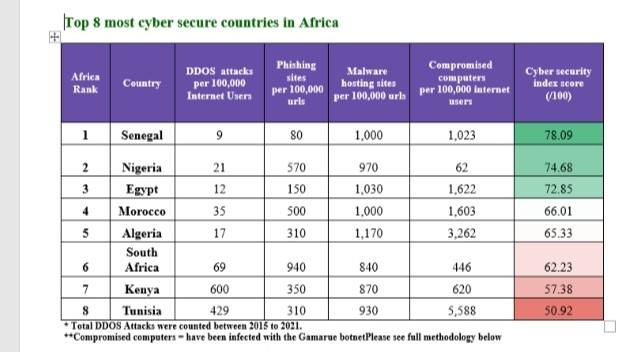
Nigeria has been profiled behind Senegal with an index score of 74.68 and the lowest number of compromised computers per 100,000 internet users in all African countries reviewed.
In the profiling done by Indusface, Senegal is named the most cyber-secure African country for businesses to allow their employees to work from, with a cyber security index score of 78.09 out of 100 out of the eight countries profiled on the continent.

Meanwhile, Egypt scores 72.85 to come third position, followed by Morocco, Algeria, South Africa, Kenya and Tunisia, who scored 66.01, 65.33, 62.23, 57.38 and 50.92 respectively.
Also, contributing to Nigeria’s top ranking is that it has the lowest number of compromised computers per 100,000 internet users (62) among all African countries reviewed. Nigeria also has the fourth lowest DDOS attacks among all African countries reviewed, with an average of 21 attacks per 100,000 internet users.
The report crowned Senegal as the most secure African country for businesses to allow employees to remotely work from, with a cyber security score of 78.09 out of 100. Senegal has the lowest number of DDOS attacks in Africa (9) during 2015 to 2021 as well as the fewest phishing sites per 100,000 urls (80) compared to all other African countries reviewed, making businesses less worried about sensitive information being stolen.
Commenting on the report, Venky Sundar, Founder and President of Indusface said: “Attracting top talent through remote work can revolutionise your business. However, it also leaves your sensitive data and assets vulnerable to hackers. Therefore, it is important to be prepared to address remote work security risks. There are a few points when recruiting talents globally:
“Firstly, you could consider which countries are least targeted by hackers and least risk to your cyber security.
“Secondly, look at regulations that govern data security. For example, GDPR is probably the gold standard when it comes to data security.
“Thirdly, research law enforcement. This indicates how quickly people will be punished when committing cybercrime.
“Fourthly, get to know the government grants. Cybersecurity grants are provided to SMBs who tend to be more susceptible to attacks.
“Fifthly, the level of cybersecurity awareness in the generation also affects how likely hackers would commit cyber crimes.”
Indusface provides six top tips for businesses that apply remote or hybrid working
“There is no one way to secure remote working but instead you should make remote work access security an integral part of your employee’s ongoing training and workplace culture. Here are eight best practices for secure remote working within your business:
- Create strong authentication: It starts by identifying the remote worker before a worker can access corporate data and assets. From this, you can build audit trails of the actions against the identity.
- Update your systems and encrypt your devices: Outdated technology could open doors to hackers with credential information like credit cards being stolen. Cases like this will have a fatal hit on your business’s reputation as well as cyber security. It is highly recommended that all your devices be updated and encrypted with SSL certificates.
- Conquer internal security risks: Working habits could lead to malware or ransomware attacks that could put your company and your clients at risk. We really recommend hosting full employee training on cyber security and making it fun. You could get your team engaged in the training by setting up phishing email simulators so they could see the potential dangers in action.
- Avoid weak or duplicate passwords: Many businesses share duplicate passwords for multiple accounts. Research shows hackers rely on weak passwords when brute forcing PoS terminals. Use an automatic password generator to create safe and secure passwords companywide.
- Only upload files to secure systems: Hackers could upload their own files with malicious code that can be executed directly on your server. Therefore, it is important to avoid storing data in unencrypted storage, leaving data on devices without password protection, and attaching sensitive information directly into an email.
- Secure web application security: Using a combination of open-source CMS and cloud-based apps increases your remote work risks. It should be considered as part of your security policy to approve web app purchases and free downloads.