



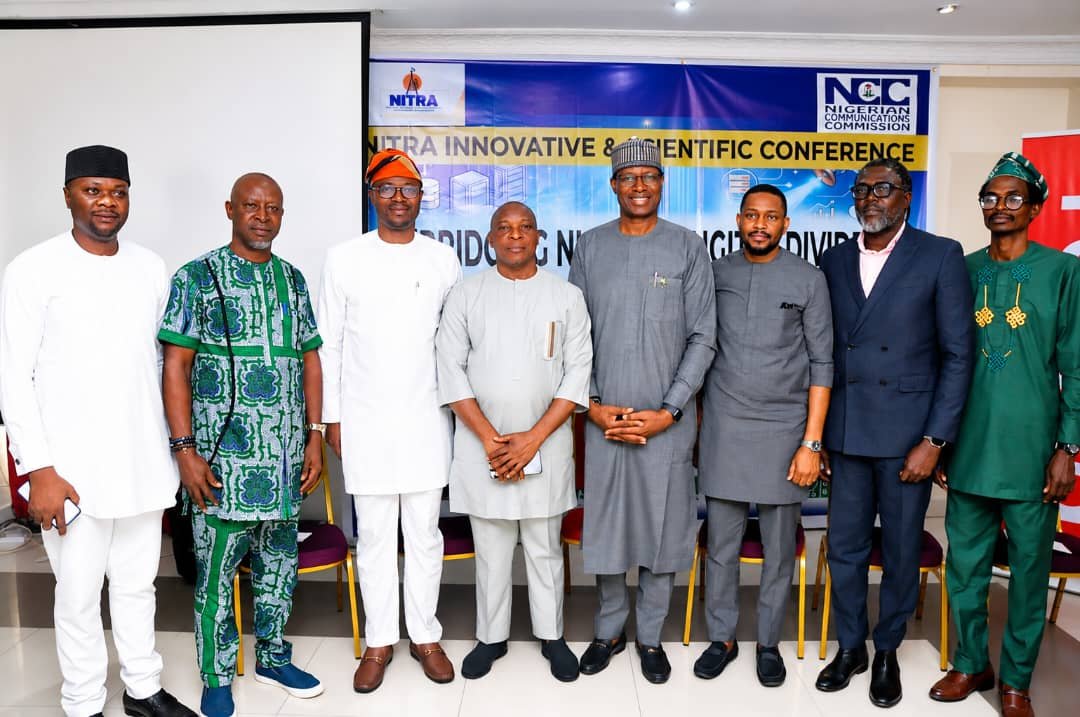
The Nigeria Information Technology Reporters Association (NITRA) successfully hosted its flagship Innovative and Scientific Conference, rallying key ICT sector leaders, policymakers, and industry experts to address the critical gaps in Nigeria’s technology landscape.
Held under the theme “Bridging Nigeria’s Digital Divide with Scientific Innovation,” the forum highlighted the urgent need to pair policy reforms and infrastructure expansion with grassroots mobilization to ensure inclusive economic growth.

Opening the conference, Chike Onwuegbuchi, Chairman of NITRA, noted that the digital divide in Nigeria is not just about infrastructure, but it’s about ensuring that our digital transformation is truly inclusive.
“We cannot build a knowledge-based economy if we leave millions of our citizens behind,” he said.
Highlighting the economic stakes, Onwuegbuchi cited research showing that full digital inclusion could inject $88 billion into Nigeria’s GDP by 2030, representing nearly 15% of the national economic output.
“Small and medium enterprises (SMEs) constitute 96% of Nigerian businesses and employ 84% of the workforce, yet many rural-based SMEs cannot access e-commerce platforms. Bridging the digital divide means ensuring everyone has access to affordable internet, digital devices, and essential digital skills, regardless of where they live or their income,” he added.
Following the opening, the conference transitioned into a high-powered panel session titled “The Place of Policy and Infrastructure in Nigeria’s Quest for Global Competitiveness Through Scientific Innovation: Roles of Different Stakeholders in Grassroots Mobilization.”
Moderating the discussion, Peter Oluka, Founder of Techeconomy, framed the conversation by identifying a missing link between high-level technology deployments and everyday citizens.
“Nigerians’ ambition to compete globally through scientific innovation rests on two pillars: policy and infrastructure. Policy sets the rules for spectrum allocation, licensing, data governance, and local content. Infrastructure is the physical engine towers, fiber, data centers, and devices. But there is a third element that connects the two: grassroots mobilization. A state-of-the-art data center means nothing to a trader in an open market or a student in a junior lab unless it translates into something they can relate to, afford, and trust,” Oluka asserted.
Panelists across telecom, software development, presales, technology journalism, and professional bodies shared insights on overcoming systemic bottlenecks.
Engr. Gbenga Adebayo, Chairman of the Association of Licensed Telecommunications Operators of Nigeria (ALTON), addressed the crippling challenges of infrastructure rollout across subnationals, particularly high Right-of-Way (RoW) fees and hidden taxes.
He noted that Right-of-Way accounts for 20 percent of deployment costs in some subnationals, and even where states claim RoW is free, they introduce development charges, education levies, and procedural fees that negate the policy.
He also emphasized that while Nigeria has significant submarine cable capacity landing in the country, inland access remains limited urging the regulator to review the Open Access Policy and democratize existing fiber capacity so operators can share infrastructure without redundant builds.
Ajibola Olude, Executive Secretary of the Association of Telecommunications Companies of Nigeria (ATCON), highlighted the pressure placed on small and medium ISPs operating alongside dominant network operators, advocating for equitable policy protections and targeted funding to sustain regional providers.
Adesina Adewale, Chairman of the Nigeria Computer Society (NCS), Lagos Chapter, stressed the need for structured digital education that connects schools directly with industry and government.
He stated that policy precedes innovation, asserting that without policy there is no innovation, while infrastructure makes the nation globally competitive. He added that the education system must merge with industry and government, noting that the NCS starts at the state level to ensure policies directly drive practical, grassroots technology programs for young people.
Emmanuel Okonji, ICT Editor at ThisDay Newspapers, cautioned against total lawlessness while calling for balanced regulatory frameworks in emerging fields like Artificial Intelligence. He warned that innovation can devolve into chaos without regulation, pointing to unguided AI deployments that lead to voice cloning, impersonation, and social media hate speech. He advised regulators to set boundaries and safety rails to protect society while designing those rules so innovators still have room to create.
Olukayode Joseph, Head of Presales at Quomodo, and Ayobami Oduwole, Chief Operating Officer at SystemSpecs, emphasized the need to direct funding toward meaningful digital literacy and functional infrastructure rather than redundant equipment purchases, ensuring local businesses and rural communities can seamlessly adopt financial technology and software solutions.
The panel concluded with a shared consensus that achieving global competitiveness requires Nigeria to align federal and state policy mandates, dismantle oppressive subnational taxes on telecom infrastructure, and invest heavily in practical digital literacy for grassroots adoption.