



By Martin Ekpeke
In a major regulatory shift designed to eliminate costly IT failures, strengthen cybersecurity, and build public trust in digital governance, the National Information Technology Development Agency (NITDA) has officially launched the National Software Quality Assurance (SQA) Framework.

Signed by NITDA Director-General/CEO, Kashifu Inuwa Abdullahi, under the authority of the NITDA Act 2007, the regulatory framework sets binding nationwide standards for how software is designed, tested, and deployed across Federal Government institutions, regulated industries, and the wider digital ecosystem.
Under the new mandate, all software projects built for government agencies must undergo independent third-party testing and receive official certification prior to going live. Compliance with the framework has now been made a compulsory prerequisite for obtaining NITDA’s official IT Project Clearance.
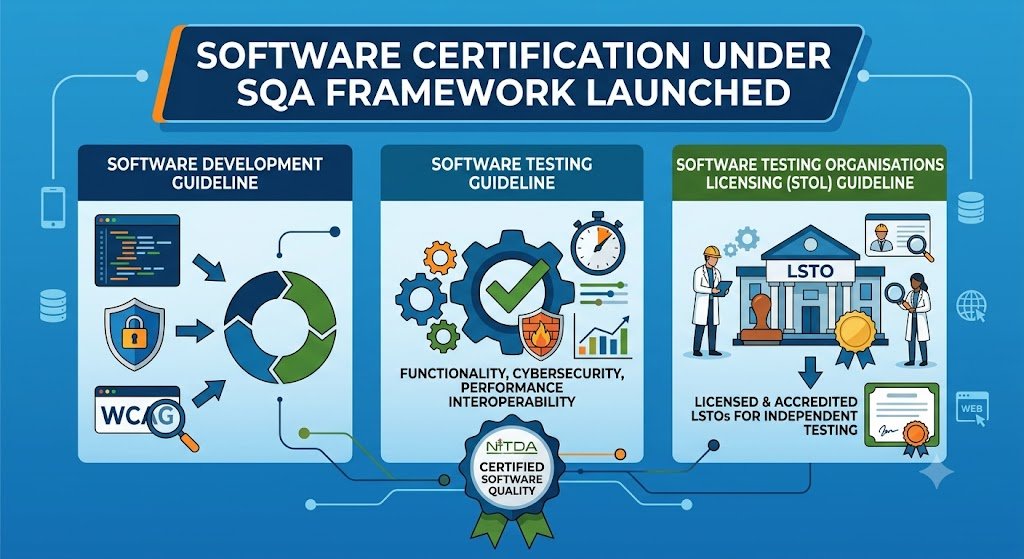
The SQA Framework unifies three complementary regulatory instruments designed to standardize the end-to-end software development lifecycle. First, the National Software Development Guideline mandates structured development lifecycles, OWASP secure coding practices, standardized system documentation, and WCAG 2.1 AA accessibility standards for citizen-facing digital services. Second, the National Software Testing Guideline establishes rigorous pre-deployment testing benchmarks for functionality, cybersecurity, performance under peak loads, and system interoperability. Finally, the Software Testing Organisations Licensing (STOL) Guideline regulates and accredits third-party, independent Licensed Software Testing Organisations to evaluate and certify software before deployment.
Recognising that a routine departmental website carries vastly different operational risks than national defense or central banking systems, the framework introduces a tiered classification model for software. Under Class A, high-impact platforms such as core banking switches, identity management databases, and power grid controls are designated as high-risk critical infrastructure and will be subject to the most stringent security standards, deep penetration testing, and specialized audit oversight by top-tier accredited testing bodies. Class B covers moderate-risk enterprise platforms, including enterprise-level business software and operational systems. Finally, Class C accounts for low-risk internal tools, which encompass basic administrative tools and low-impact internal software applications.
NITDA highlights three main strategic advantages this regulatory transition will deliver to the country. First, it ensures reliable public digital services so citizens and public agencies gain bug-free digital platforms that safeguard taxpayer investments against catastrophic system crashes and severe cyber vulnerabilities. Second, it fosters the creation of a new local industry by regulating the market for independent software testing, which establishes a vibrant ecosystem for indigenous tech entrepreneurship, promotes international certifications, and creates high-skilled jobs for Nigerian engineers. Finally, it builds global trust in “Made-in-Nigeria” software, as rigorous and standardized quality assurance instills international confidence in locally developed technology, enabling Nigerian developers to compete effectively in global markets and attract Foreign Direct Investment.
“Quality is the foundation of digital trust. With this Framework, every software solution serving Nigerians, whether built for government or the private sector will meet clear national standards for security, reliability, and interoperability. This is how we modernise government technology and position Nigerian software to compete on the global stage,” added Inuwa in a statement released today.
The SQA Framework will take full effect in the second quarter of 2027. During the transition period, NITDA will execute nationwide stakeholder engagement sessions, capacity-building programs, and the formal accreditation process for software testing houses.
The Agency announced that an Expression of Interest (EOI) will be issued shortly for prospective testing organizations seeking licensing, giving local technology firms ample opportunity to build their technical capacity and align with the new national standards.