




By Martin Ekpeke
South Africa has emerged as the undisputed leader in generative AI adoption across the African continent, leaving its major tech rivals, Nigeria and Kenya, trailing far behind.

According to the ‘Global AI Diffusion Q1 2026’ report, newly released by Microsoft’s AI Economy Institute, a widening digital divide is opening up across the region as generative AI transitions from an experimental novelty into core economic infrastructure.
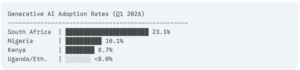
The comprehensive study, which tracked generative AI usage across 147 countries, reveals that 23.1% of South Africa’s working-age population actively used a generative AI product in the first quarter of 2026. This secures South Africa the top spot in Africa and 46th globally, making it the only African nation to break into the global club of “mid-tier” AI economies.
While South Africa’s figures represent a major milestone, the data for other leading African tech hubs present a sobering reality.
- Nigeria: Despite being home to a vibrant, digitally engaged, and youthful population, the continent’s largest economy ranked a distant fourth regionally. Just 10.1% of its working-age population uses generative AI—less than half of South Africa’s adoption rate.
- Kenya: Often dubbed the “Silicon Savannah,” Kenya lagged even further behind at 8.7%.
- East Africa & Beyond: The picture across the wider sub-Saharan region remains grim, with nations like Uganda and Ethiopia reporting adoption rates well below the 8% mark.
Generative AI Adoption Rates (Q1 2026)
“Generative AI is actively reshaping hiring practices, boosting productivity, and defining economic competitiveness,” the report notes. “For African nations lagging in adoption today, the long-term economic costs could be dire.”
Microsoft’s report places Africa’s figures within an unforgiving global context. While high-income economies dominate the upper echelons of the diffusion index due to robust broadband penetration and heavy enterprise investment, the rest of the continent is battling a convergence of structural barriers.
Analysts point to a restrictive triad holding back adoption:
- The Infrastructure Deficit: Generative AI tools are cloud-heavy and require stable, high-speed internet. However, reliable and affordable broadband access remains deeply fragmented across sub-Saharan Africa. Furthermore, while smartphone adoption is accelerating, it still lags behind the world’s leading AI economies, constricting the mobile-first pathways typical of emerging markets.
- The Affordability Gap: Economic realities present severe complications. More sophisticated consumer AI tools and enterprise software are priced primarily for Western markets. When adjusted for purchasing power parity, the cost of these tools becomes prohibitively high, creating structural headwinds that even tech-savvy enthusiasm cannot overcome.
- Siloed AI Literacy: Generative AI literacy is highly unevenly distributed. On the continent, awareness and usage tend to remain siloed within major urban centers and among knowledge workers who already have exposure to advanced digital workflows.
Why South Africa is Winning
South Africa’s position as a clear outlier is no accident. Experts attribute the country’s relative success to simultaneous advantages across all major economic dimensions.
Compared to its continental peers, South Africa boasts significantly higher broadband penetration, a larger formal knowledge economy, and aggressive corporate investment in digital transformation. As businesses in Johannesburg and Cape Town rapidly integrate AI into core workflows, the country is widening the gap, setting a benchmark and a warning for the rest of the continent.