


By Martin Ekpeke
For years, the suburban dream in areas like Ikorodu in Lagos or Kubwa in Abuja came with a digital asterisk: spotty connections and the dreaded searching for signal icon. But as of mid-2026, the landscape has shifted into a high-stakes arena.

With Starlink firmly entrenched as Nigeria’s second-largest ISP and Amazon Kuiper launching its commercial Ka-band services, global tech giants are descending on Nigeria’s residential hubs. Yet, local players like Spectranet and FibreOne aren’t backing down.
Instead, they are doubling down on hyper-local service models to protect their home turf.
Starlink’s ascent to the number two spot wasn’t just about speed; it was about consistency. In suburban neighborhoods where fiber cables are often severed by road construction, satellite internet offers a set it and forget it solution.
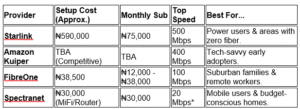
Starlink currently has over 66,000 subscribers and provides speeds between 150 and 500 Mbps. However, the service requires a high initial investment of roughly ₦590,000 for hardware. The monthly subscription fee has also increased to ₦75,000. Meanwhile, Amazon’s Project Kuiper recently secured a seven-year landing permit. This service promises speeds up to 400 Mbps. Kuiper intends to offer lower hardware costs than Starlink to attract households that find the SpaceX entry price too expensive.
Meanwhile, local ISPs are fighting back with a weapon the satellites can’t replicate: physical presence and tailored pricing.
Spectranet and FibreOne have shifted their strategy to focus on community-specific reliability. In Ikorodu and other neighborhoods of Lagos, FibreOne has aggressively expanded its fiber-to-the-home (FTTH) footprint, offering Lite plans starting around ₦12,000 for unlimited data. While the speeds (16–30 Mbps) don’t match Starlink’s 500 Mbps, they are more than sufficient for a family streaming Netflix and attending Zoom meetings at a fraction of the cost.
Fiber remains the best option for low latency, which is essential for gamers. Even Low Earth Orbit satellites sometimes struggle to match the low latency provided by fiber connections.
Local providers also offer physical technical support as a Spectranet or FibreOne technician can arrive at a home in Kubwa for instance, within 24 hours if a router fails. In contrast, Starlink users often have to rely on digital support tickets for assistance.
Cost-to-Speed Ratio: The Suburban Breakdown
For the average consumer in 2026, the choice usually boils down to the “Cost-per-Mbps” vs. the “Wallet Impact.”
 The “Battle for the Soul” of Nigeria’s suburbs isn’t being won by the fastest provider, but by the most accessible one.
If you are a high-earning tech professional in a new site area of Kubwa where infrastructure is still being laid, Starlink or the new Amazon Kuiper are your best bets. But for the millions in established suburban blocks in Ikorodu, the Hyper-Local model of local ISPs offering affordable monthly bills and local support remains the undisputed champion of the Nigerian household budget.
The entry of Amazon only means one thing for you, the consumer: better prices are coming, and the days of searching for signal are finally numbered.