



By Martin Ekpeke
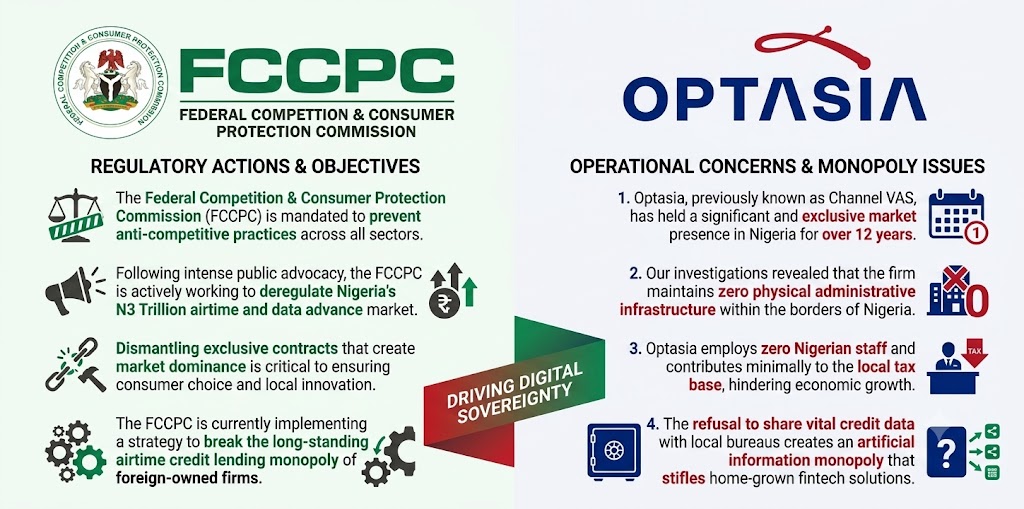
In a major policy shift aimed at ending substantial capital flight and boosting domestic investment, President Bola Tinubu has directed the Federal Competition and Consumer Protection Commission (FCCPC) to dismantle the 12-year exclusive monopoly held by South African firm Optasia (formerly Channel VAS) over Nigeria’s micro-utility lending market.

The high-stakes intervention opens up an estimated N3 trillion ($2 billion USD) annual market in airtime credit and data advance services to domestic tech companies. Following the directive, the FCCPC has finalized a shortlist of nine Nigerian-owned fintechs to be onboarded into the ecosystem, effectively turning the tide on over a decade of single-player dominance.
Airtime credit lending is a vital lifeline allowing millions of low-income Nigerians to borrow small amounts of airtime or data and repay upon their next top-up has been exclusively funneled through Optasia for more than a decade.
According to authoritative commission sources, the Presidency was swayed by alarming findings regarding the foreign firm’s operational footprint. Allegations presented by the FCCPC reveal that Optasia has extracted massive revenues from Nigerian consumers for 12 years while maintaining zero physical administrative infrastructure within Nigeria. Furthermore, the company employs no Nigerian staff and contributes minimally to local tax revenues. Finally, Optasia refuses to share vital credit metrics with local credit bureaus, which has created an artificial data monopoly that actively stifles home-grown fintech solutions.
“The Commission’s argument is clear: deregulating this subsector will aggressively promote competition, honor the Nigeria First Technology Policy, generate direct tech employment for our citizens, and permanently halt the massive capital flight to South Africa hitherto perpetrated by Optasia,” an FCCPC official stated on the condition of anonymity.
The policy shift comes at a critical time as Nigeria grapples with foreign exchange shortages and aggressively seeks to retain value within its domestic digital economy.
Optasia is fighting back. The South African firm has reportedly filed an interim injunction before a Federal High Court to restrain the FCCPC from enforcing any deregulation or onboarding new competitors.
However, the FCCPC appears unyielding. Acting Executive Vice Chairman of the FCCPC, Adamu Abdullahi, previously issued a stern warning to anti-competitive players in the digital space:
“No single company, regardless of origin, will be allowed to hold an entire digital subsector hostage through exclusive contracts that do not serve Nigerian consumers.”
The FCCPC is expected to publish comprehensive implementation guidelines within the next 60 days to outline the unwinding of the monopoly. To ensure compliance where the previous model failed, new entrants will face strict performance standards, including mandatory local data hosting, minimum Nigerian equity participation, and transparent credit data sharing.
The nine indigenous tech companies officially shortlisted to break the monopoly include Technotrends Platforms Nigeria Limited, Total Tim Nigeria Limited, and Fonyou Technologies Nigeria Limited. They are joined by Rane Interactive Medien CLS Limited, MRS Innovation Nigeria Limited, and Mode NG Applications Nigeria Limited. The remaining shortlisted firms are ERL Telecoms Service Limited, Cloud Interactive Associate Limited, and Coverage Broadband Limited.
The breakthrough follows months of escalating pressure from local tech advocates and intense social media campaigns calling out the regulatory gridlock that favored foreign entities over local innovators.
Reacting to the development, a senior Nigerian fintech executive characterized the decision as a historical tipping point for West African tech. “For 12 years, a single foreign entity has extracted trillions of Naira from everyday Nigerian consumers with almost zero local reinvestment. That model is officially dead. This is a watershed moment for financial inclusion and indigenous tech sovereignty.”