


By Martin Ekpeke
In a digital landscape where every millisecond counts, the Internet Exchange Point of Nigeria (IXPN) is fundamentally altering how data moves across the country by keeping local traffic within national borders. By so doing, the exchange is delivering a different experience for the same volume of traffic, drastically reducing delays for Nigerian internet users.
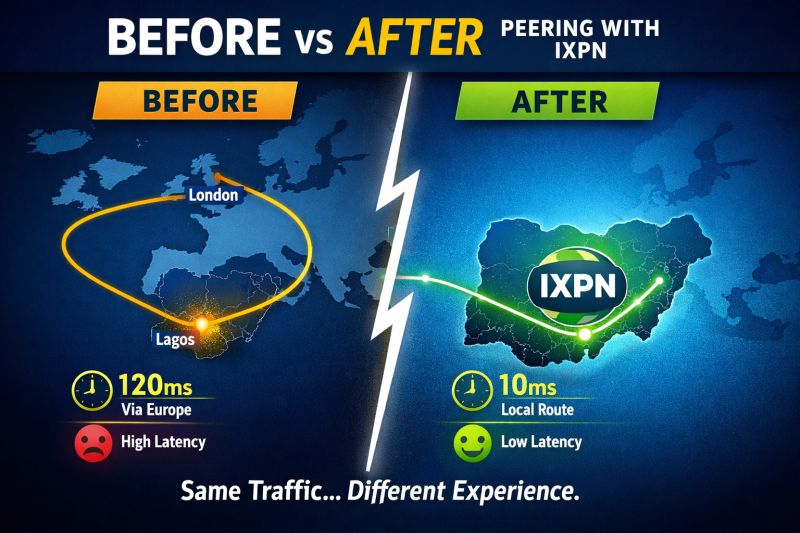
Historically, a significant portion of internet traffic originating in Nigeria has been forced to travel through international transit paths, often routing through Europe before returning to its final destination in Nigeria.
According to Muhammed Rudman, CEO of IXPN, this inefficient routing creates a heavy burden on network performance, explaining that without local peering, round-trip time (RTT) and latency levels typically reach 120ms or higher, depending on the specific network conditions and the distance the data must travel.
But local peering with IXPN makes the difference. “Same traffic. Different experience,” Rudman noted, emphasizing that the physical path data takes has long been the primary bottleneck for Nigerian connectivity.
To solve this, Rudman explained that IXPN utilizes a distributed interconnection fabric spanning multiple Points of Presence (PoPs) across the country. This infrastructure allows for direct Autonomous System (AS)-to-AS routing, effectively cutting out the unnecessary international hops that plague traditional transit.
The impact on speed is immediate and measurable, setting new benchmarks for the region. “Networks connected to IXPN now experience an average latency of approximately 10ms across different states. Within Lagos, where multiple IXPN PoPs are interconnected, latency can drop to as low as 1ms,” the company stated in a LinkedIn post.
By localizing traffic, IXPN isn’t just making the internet feel faster; it is making it more reliable and cost-effective. The reduction in hop counts means there are fewer points of failure and less reliance on expensive international bandwidth.
“This is the power of traffic localization, reduced hop count, and efficient routing. The result is a more robust digital ecosystem that supports everything from seamless video conferencing to high-speed financial transactions, all while keeping Nigerian data within Nigeria,” Rudman posited.