




By Epiphanus Obia
Financial institutions and fintech companies across West Africa have been urged to aggressively embrace local peering to curb operational costs, eliminate transaction latency, and secure the continent’s digital economy.

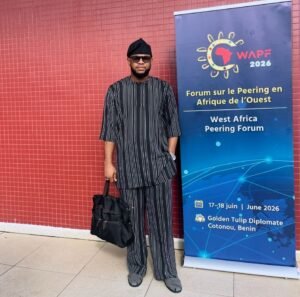
Raphael Iloka, Manager, Sales and Marketing at the Internet Exchange Point of Nigeria (IXPN), made the call during a presentation at the West Africa Peering Forum (WAPF) 2026 held in Cotonou, Benin Republic.
Speaking on the theme, ‘Banks, Fintechs & The IXP: Why Financial Institutions Are the Next Big Peering Opportunity in West Africa,’ Iloka pointed out a critical infrastructure gap, revealing that despite handling billions in transaction volumes, a massive amount of local financial traffic still leaves Africa before returning to complete payments.
“Banks and fintechs are now among the biggest consumers of internet infrastructure in Africa, yet they remain one of the least connected sectors to Internet Exchange Points (IXPs),” Iloka said.
According to him, West Africa’s rapid emergence as a dominant fintech hub means financial services are now fundamentally internet-dependent, but sluggish peering adoption among these institutions introduces severe operational setbacks.
He highlighted three main consequences of this connectivity gap, beginning with the latency tax, where routing local transactions through international servers introduces unnecessary delays to real-time financial systems that depend strictly on milliseconds. Additionally, financial institutions face inflated expenses by relying on costly international internet transit for traffic that could otherwise be exchanged locally. Finally, a lack of local interconnection increases vulnerability, leaving the banking ecosystem overly exposed to disruptions and outages on international subsea cables.
Iloka explained that interconnecting at local IXPs provides immediate commercial and technical benefits for banks and fintech firms. “By keeping traffic local, institutions unlock faster transaction processing times, enhanced API performance, and improved service uptime,” he added.
Furthermore, local peering lowers bandwidth expenses by reducing international transit reliance, while giving financial entities direct, optimized access to cloud providers and Content Delivery Networks (CDNs).
Iloka’s presentation underscored that the next generation of financial infrastructure in West Africa will demand ultra-low latency that only local IXPs can sustain. This includes the complex web of APIs connecting third-party fintechs, real-time AI fraud detection engines, and critical identity verification systems like Nigeria’s Bank Verification Number (BVN) and National Identification Number (NIN).
Additionally, upcoming Central Bank Digital Currencies (CBDCs) and regional cross-border payment systems require a resilient, localized West African IXP backbone to function securely.
“The next wave of IXP growth in Africa may not come from Internet Service Providers (ISPs) alone; it may come from financial institutions. The next major peering ecosystem in Africa may not be social media or streaming, it may be finance,” he posited.