



The domain INEC used to host official election result documents has lapsed and is in third-party hands. A cloud storage bucket holding result PDFs no longer exists. Presidential results for 19 states and the FCT remain inaccessible. The complete 2023 governorship record appears entirely gone. Legal experts confirm this violates the Electoral Act 2026.
By Epiphanus Obia

Try clicking the links on INEC’s website that are supposed to take you to the official results of Nigeria’s 2023 general election, be sure to follow the addresses INEC published too. You would notice that for most states, here is what loads:
A yellow bar across the top of a blank page, displaying three words: “Buy this domain.”
One such link reads: `http://ww38.docs.inecelectionresults.net/elections_prod/1292/state/01/lga/03/ward/04/pu/003/003-1677389006.pdf`
That address was supposed to return a polling unit result document. The number embedded in the filename (`1677389006`) is a Unix timestamp, and it converts to 26th February 2023, which is the day after the presidential election. These were the result documents created during and immediately after the counting process.
The domain `inecelectionresults.net` lapsed, and someone else seems to have purchased it. The official links to Nigeria’s 2023 election results now point to a third party’s address.
Three things that URL reveals
 The link starts with `http://` and not `https://`. Official election result documents were being delivered to the public over an unencrypted connection. No protection for the data in transit. Every journalist, petitioner, or citizen who downloaded a result PDF from this system was doing so without encryption.
Also, the subdomain is `ww38`, not the standard `www`. This indicates a large, load-balanced server infrastructure (at minimum 38 servers) built deliberately and at scale to handle significant traffic. Someone designed this system and then allowed the parent domain to expire.
The file path drills down to individual polling unit level: election, state, LGA, ward, polling unit, document. The most granular record of an election possible. Every polling unit in Nigeria had a corresponding address in this system, and every one of those addresses now leads to a parking page.
Two failures, not one
Not all of the missing results produce the same error. That matters, because this is not one infrastructure failure. It is two, in two different places.
For most states, clicking the result links produces the parking page. The domain lapsed, someone bought it, and the old address now leads somewhere else.
For other states; Ekiti, Kogi, Osun and others, clicking the link produces a different message entirely:
NoSuchBucket — The specified bucket does not exist
BucketName: etransmission-result-docs
This is an Amazon Web Services error. It confirms that INEC was storing official e-transmission result documents, (the PDFs generated by BVAS machines during the 2023 elections) on AWS S3 cloud storage. The region: `eu-west-2` is London and Dublin. Nigerian electoral records, stored in Europe, in an arrangement never publicly disclosed.
 The bucket called `etransmission-result-docs` no longer exists, and the documents it held are gone.
Old infrastructure, new infrastructure and the full picture
During this investigation, something else became clear that shapes the finding considerably.
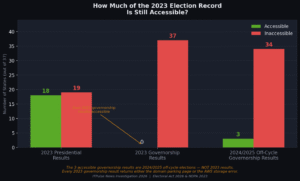
Three states return accessible governorship results: Anambra, Edo, and Ondo. At first, this appeared to mean some 2023 records had survived. On closer examination, they had not. Edo held a governorship election in September 2024, Ondo held one in November 2024 and Anambra held one in 2025. These are not 2023 results. They are more recent elections stored on newer infrastructure that has not yet failed.
When results from elections conducted before 2023 were checked, they returned the same errors, the same domain parking page, the same AWS bucket message. The same infrastructure failure that swallowed the 2023 general election results also swallowed the records that preceded them.
The picture that emerges is this: INEC built new infrastructure for elections conducted after 2023 and left the old system (the one holding the 2023 general election record) to collapse without migrating or preserving what it held.
The consequence for the 2023 general election specifically is more serious than the headline number of inaccessible presidential states suggests. The 2023 governorship results appear entirely inaccessible not partially, not mostly. Every state’s 2023 governorship result returns either the parking page or the AWS error. The complete governorship record of Nigeria’s most contested recent election does not appear to be reachable through any of INEC’s published links.
What is and is not accessible
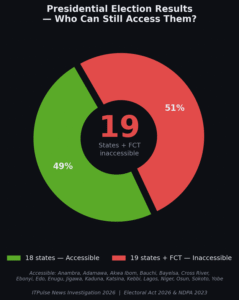
For the 2023 presidential election, 18 of Nigeria’s 36 states and the FCT return accessible result documents. The states where results became accessible during the course of this reporting (Bayelsa, Edo, Lagos, Osun, and Yobe) suggest some quiet, unexplained maintenance activity taking place in the background. INEC has not explained when, how, or why specific states were restored while others remain inaccessible. As of the date of conducting this audit(19th May 2026), presidential results for at least 19 states and the FCT remain inaccessible through INEC’s published links.
For the 2023 governorship and state assembly elections, the picture hits harder, not even one of the states have accessible 2023 results. The three governorship results that appear accessible belong to post-2023 elections possibly hosted on different infrastructure.
What the law says
The Electoral Act 2026 (signed into law in February 2026, repealing the Electoral Act 2022) is specific about what INEC must do with election result documents.
Section 62(2) requires INEC to compile, maintain, and update, on a continuous basis, a National Electronic Register of Election Results, a distinct database of polling unit by polling unit results for every election the Commission has conducted. Section 62(3) entitles any person to obtain a certified copy of any result in the register. Section 68 requires results to be posted on INEC’s website. The obligation has no expiry date.
Oladipupo Ige, popularly known as Dipo, Policy and Advocacy Director at the Data Privacy Law Association Nigeria (DPLAN), confirmed what these provisions mean for INEC’s current state. “The post-election publications and maintenance of a database is not subject to any time limitations or retention period,” he said.
On whether the lapsed domain and inaccessible results constitute a legal breach, he says, “Yes, it definitely does. The law mandates a special purpose built database for the electronic reporting and repository of election results. The law mandates that this database must be constantly updated. Therefore, the fact that a special purpose database that is being maintained and updated properly does not exist is a direct violation.”
He added that the obligation is not limited to presidential results. “It comprises of all elections conducted by the Commission.”
 What this does to justice
Election result documents are evidence of democracy and not just administrative files.
Emmanuel Okpara, Privacy and Cyber Law Consultant and Legal and Compliance Director at DPLAN, described what happens when that evidence disappears. “If documents become inaccessible through officially published channels, litigants and legal representatives may face practical evidentiary challenges where reliance was placed on publicly available official sources. Civil society organisations and election observers may encounter limitations in conducting independent verification exercises. Journalists and researchers may face difficulties in validating electoral claims and historical data.”
Beyond the immediate practical consequences, Okpara pointed to something harder to quantify but more lasting. “Public confidence may suffer, because the general public will further lose confidence in the system. Trust in electoral systems increasingly depends not only on the conduct of elections but also on confidence in the digital infrastructure supporting them. Transparency is not merely the existence of records somewhere in an internal archive; transparency also requires reasonable public verifiability.”
Muhammed Bello Buhari, Programmes Officer at Paradigm Initiative Nigeria, made the point about democratic legitimacy directly. “In a constitutional democracy, an election is a public ledger; the electoral umpire does not own the results, they merely custody them for the citizens,” he said. “When INEC allows a domain like inecelectionresults.net to lapse into the hands of third-party speculators, or deletes the cloud storage buckets holding presidential results for 19 states and the FCT, it actively erases the evidence of our collective democratic choice.”
On what disappearing records mean for scrutiny: “Electoral scrutiny cannot happen in a vacuum, it requires immutable, verifiable data. When these records vanish or become selective, democratic accountability is effectively paralysed. It truncates the work of researchers, blindfolds watchdog organisations, and systematically protects bad actors by starving the public of comparative historical data.”
Storing Nigeria’s election records in Europe
The AWS error confirms that INEC was storing official election documents on servers in London and Dublin without publicly disclosing this arrangement. Under Section 41 of the Nigeria Data Protection Act 2023, transferring personal data outside Nigeria requires either an adequacy decision from the NDPC, binding corporate rules, standard contractual clauses, or another recognised derogation. There is no public record of INEC obtaining any of these.
Ige addressed the cross-border storage directly. “If there are no systems in place, then it will be a problem due to the fact that it is national data. The personal data of Nigerians will be at risk and the entire data sovereignty becomes a farce. This is the domain of the NDPC to investigate these practices and find measures to address them.”
Okpara drew the distinction between cloud use and accountability failure. “The use of international cloud infrastructure is not inherently unlawful,” he said. “However, from a privacy, cybersecurity, and sovereignty perspective, the concern is less about foreign cloud use itself and more about whether adequate transparency, oversight, and governance mechanisms accompanied that decision.” He identified specific questions that INEC has never publicly answered: jurisdiction exposure, access management, audit trails, encryption standards, incident response, and disaster recovery.
Buhari put it plainly. “Who holds the encryption keys to these storage buckets? What bilateral or commercial legal frameworks protect this data from foreign state access or third-party subpoenas? By failing to answer these questions transparently, INEC has violated the public’s right to know.”
The full picture
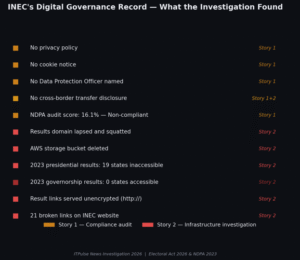
 This is the second and final story in ITPulse News’s investigation into Nigeria’s digital political and electoral infrastructure. The first examined how 21 registered political parties and INEC comply with the NDPA 2023 and the NDPC’s GAID 2025, of which not one of the subjects passed.
This story finds the second layer. The institution responsible for conducting and preserving the record of Nigerian elections has allowed the infrastructure holding that record to collapse. The 2023 presidential results are inaccessible for at least 19 states. The 2023 governorship results appear entirely inaccessible. The result links used unencrypted connections. The cloud storage was in Europe. The domain expired and the bucket deleted. INEC built new infrastructure for subsequent elections and left the 2023 record behind.
Buhari named what looking at both investigations together reveals. “No privacy policy, no designated Data Protection Officer, no cookie notice, a lapsed results domain, an unencrypted HTTP delivery system, and deleted cloud storage buckets — it paints a devastating portrait of absolute systemic breakdown.”
Okpara outlined what INEC must do immediately: an independent technical and legal audit, restoration of inaccessible records through secure and authenticated channels, full migration to modern cybersecurity standards, and a formal digital governance framework incorporating domain lifecycle management, backup protocols, long-term preservation policies, and periodic cybersecurity audits. “The broader lesson is that electoral infrastructure must increasingly be viewed as critical national information infrastructure,” he said. “The security of ballots and the security of digital systems supporting those ballots should be treated with equal seriousness.”
Ige’s recommendation was direct. “Simply comply with the law. Engage experts in the field of data collection and analysis. Engage web developers to properly fix the website and upload all necessary data. Employ a DPO. INEC should enhance its cyber information capacity and adhere to the stipulations of the law.”
What INEC said
A formal right-of-reply letter was sent to INEC on 25th May 2026 containing nine specific questions covering the lapsed domain, the inaccessible results, the restored states, the unencrypted links, the AWS storage arrangement, the deleted bucket, and the absence of a privacy policy and Data Protection Officer.
No response was received.
INEC was first contacted on 7th May 2026 for the first story in this series. No response was received then either.
The Electoral Act 2026 requires INEC to maintain a continuously updated National Electronic Register of Election Results, permanently accessible to the public. Section 60(3) of the same Act now gives statutory recognition to the INEC Result Viewing Portal as a legally enforceable mechanism.
As at the time of publication, the domain is still lapsed, the bucket is still gone, and the 2023 governorship record is still inaccessible. The 2027 election meanwhile, is less than 10 months away away.